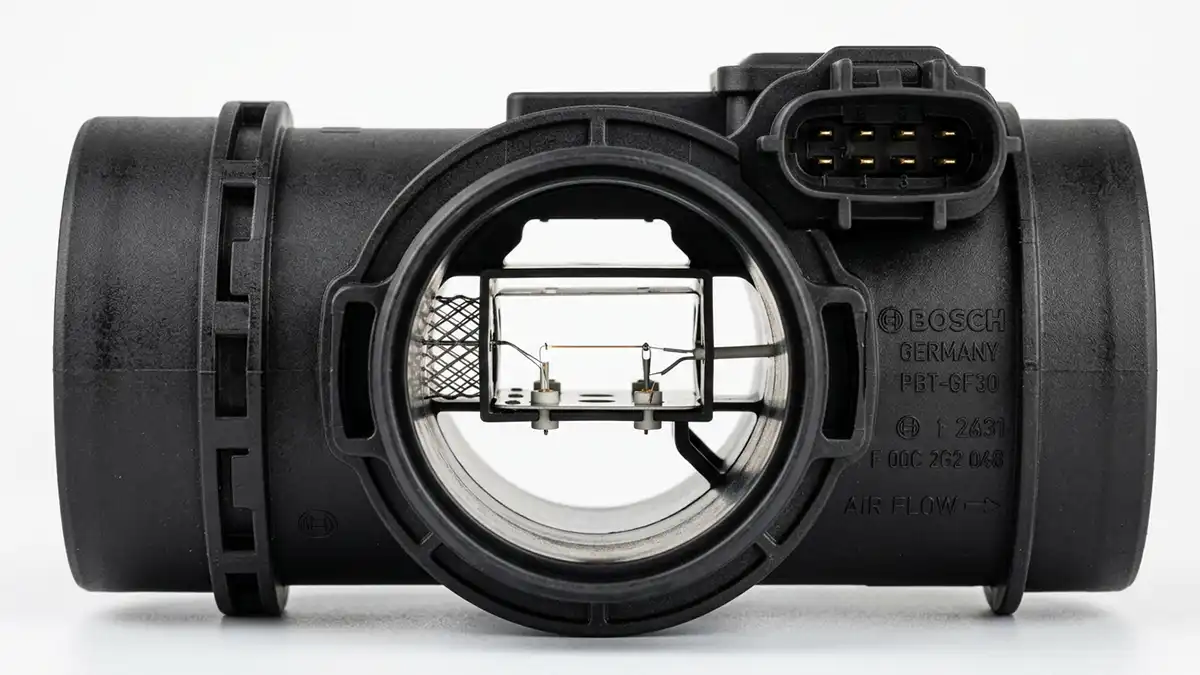
The mass air flow (MAF) sensor is a small part with a big job. It sits in the air intake tube between the air filter and the engine, measuring how much air the engine is pulling in. The engine computer uses that number to calculate how much fuel to inject. When the MAF sensor fails or gets dirty, the engine gets the wrong air-to-fuel mix, and the car starts running poorly.
If your MAF sensor has gone bad, you’re typically looking at $150 to $400 total at a shop in the U.S. The part runs about $50 to $250, and labor adds $50 to $150. If you do the job yourself, you pay only for the part. This article explains what drives that price, how to tell whether the sensor is really the problem, and when cleaning can save you the cost of a replacement.
What the MAF sensor does
The MAF sensor’s job is to measure the mass — the weight — of the air flowing into the engine. That reading is one of the most important inputs the engine computer uses. Based on it, the computer sets fuel injection, spark timing, and even transmission shift points.
The sensor works with a tiny heated wire or film placed in the intake airstream. As air flows past, it cools the element, and the sensor measures exactly how much cooling occurs. More cooling means more air, so the computer adds more fuel to match. This constant measurement keeps the air-fuel ratio near ideal — not too lean (too much air) and not too rich (too much fuel).
When the sensor can’t measure accurately — because it’s dirty, contaminated, or failing — the computer gets bad data. It then adds either too much or too little fuel. That’s when drivability problems start.
Symptoms of a failing MAF sensor
MAF sensor problems show up in a handful of recognizable ways:
- Rough idle or stalling — the engine may idle unevenly or die at stoplights.
- Poor acceleration or hesitation — the car feels flat or stumbles when you press the gas.
- Bad fuel economy — the wrong air-fuel mix wastes gas.
- Black smoke or soot — a sign the engine is running too rich.
- Hard starting — the engine may crank longer than normal or need a few tries.
- Check engine light — often with codes like P0101 (MAF circuit range/performance) or P0171 (system too lean).
Keep in mind that all of these symptoms can have other causes. A vacuum leak, a bad oxygen sensor, or a clogged fuel filter can mimic a MAF problem. That’s why diagnosis matters before you spend money on a part.
Diagnosing the problem before you replace anything
Don’t replace the MAF sensor just because the symptoms match. Plug in your code reader and see what codes are stored. Two codes point strongly at the MAF sensor:
- P0101 — mass air flow circuit range/performance problem. The computer’s MAF reading is outside the expected range.
- P0171 — system too lean. The computer detects too much air or not enough fuel. A dirty or weak MAF sensor can cause this, but so can vacuum leaks and low fuel pressure.
A good shop will also compare the live MAF reading to the manufacturer’s expected values. At idle, for example, most engines show a MAF reading between 2 and 7 grams per second — but the “correct” number varies by engine, so a technician uses the service manual, not a general rule. Many scan tools display the MAF reading in real time, which lets you see whether it responds smoothly as you rev the engine.
If the sensor is simply dirty, cleaning may fix it (more on that below). If it’s genuinely failed, it needs to be replaced.
MAF sensor replacement cost breakdown
Here’s what you can expect to pay in the U.S.:
| Item | Typical range | Notes |
|---|---|---|
| Aftermarket MAF sensor (part only) | $50 – $150 | Established brand-name aftermarket parts usually work fine |
| OEM MAF sensor (part only) | $150 – $250+ | Original manufacturer parts cost more |
| Labor at a shop | $50 – $150 | Usually a half-hour to an hour |
| Total at a shop | $150 – $400 | Part plus labor |
| DIY total | $50 – $250 | Just the part, plus about 20 minutes of your time |
These are typical U.S. market ranges. Some vehicles cost more: high-end or European cars can push the total past $500, and some sensors are sold as a single unit with the housing, which costs more than a bare sensor.
What affects the price
Several factors move the price up or down:
- OEM vs. aftermarket parts. Original equipment manufacturer (OEM) parts are made to the carmaker’s exact specifications and cost more. Aftermarket sensors from established brands are often fine, but cheap no-name sensors are a gamble — a bad one can throw the same codes the old one did. Read reviews and stick with known brands.
- Vehicle make and model. A common car with a simple, accessible sensor costs less. Some vehicles have the sensor mounted in a spot that’s hard to reach, which adds labor time.
- Shop labor rates. Independent shops typically charge $80 to $150 per hour. Dealerships run higher, often $150 to $200 per hour. The MAF job is usually quick, so labor is a smaller part of the bill than on most repairs.
- Whether the housing is included. Some vehicles require replacing the sensor and its plastic housing as one assembly. That part costs more than the bare sensor.
Can you clean a MAF sensor instead?
Sometimes. MAF sensors fail in two main ways: they get dirty, or they genuinely break. If the sensor is coated in dust, oil, or dirt — often from a clogged or over-oiled air filter — a dedicated MAF cleaner may restore it.
The process is simple: remove the sensor from the intake tube, spray it with MAF sensor cleaner (available at auto parts stores for about $8 to $12), let it dry, and reinstall it. Do not use brake cleaner, carburetor cleaner, or water — these can damage the delicate sensing element. Also, never touch the wire or film element with your fingers; the oils from your skin can ruin it.
Cleaning is cheap and worth trying if the sensor is visibly dirty. But it’s not a guaranteed fix. If the sensor is actually burned out or internally failed, cleaning won’t help, and you’ll still need a replacement. If cleaning fixes it, the check engine light may take a few drive cycles to go off on its own — or you can clear it and watch to see whether the code returns.
Should you DIY or hire a shop?
Replacing a MAF sensor is one of the easier jobs on most cars, which is good news for your budget. On many vehicles it’s a single electrical connector plus one or two screws or clips, and the whole job takes 15 to 30 minutes.
- DIY is a good fit if you’re comfortable unplugging an electrical connector and using a screwdriver. You save the labor charge and just pay for the part.
- A shop makes sense if you’re not sure the MAF sensor is actually the problem, or if your vehicle has the sensor buried under other components. Paying for diagnosis can be cheaper than buying a part you didn’t need.
One caution: if you clear the codes after replacing the sensor and the light comes right back, the sensor may not have been the real problem — or the new part is defective. Double-check that the connector is fully seated and that the intake tube has no leaks.
Frequently asked questions
How long does a MAF sensor last? Most MAF sensors last the life of the vehicle, which is why replacement usually happens because of contamination or an electrical failure rather than normal wear. There’s no standard mileage interval. If you see symptoms and codes like P0101 or P0171, have the sensor checked rather than replacing it on a schedule.
Will a dirty MAF sensor hurt my engine? Not directly — the bigger risks are drivability and fuel economy. But if a failing MAF sensor causes a severe lean condition, the engine can run hot and, in rare cases, misfire. A misfire that’s ignored can damage the catalytic converter, turning a small repair into an expensive one. The P0300 page explains misfires and their risks in more detail.
Can I drive with a bad MAF sensor? Usually yes, for short distances — the car will likely run rough and burn more fuel, and it may stall. But don’t drive far with a flashing check engine light or a severe misfire, and fix the problem soon. A long drive with a lean condition can damage the catalytic converter.