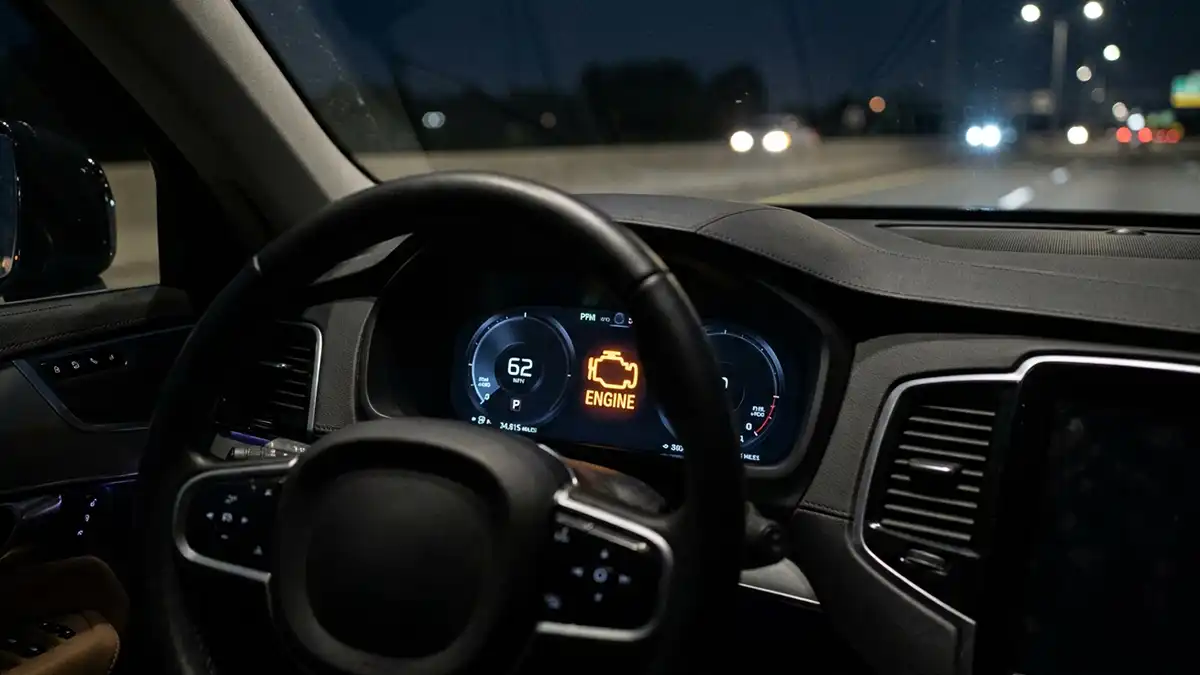
Toyotas are known for reliability, but even the most dependable cars throw a check engine light eventually. The good news is that on Toyotas, most of the time the light means something small and fixable — a loose gas cap is the classic example — not a catastrophic failure.
This article covers the ten most common causes of a Toyota check engine light, the codes that go with them, and what each fix typically involves. All of them are diagnosed the same way: plug in a code reader, read the code, and look up what it means. Here’s the quick list, with the details below it.
The 10 most common causes at a glance
| # | Cause | Typical code(s) |
|---|---|---|
| 1 | Loose or faulty gas cap | P0442, P0455, P0456 |
| 2 | Catalytic converter trouble | P0420, P0430 |
| 3 | Oxygen sensor failure | P0135, P0141 |
| 4 | Engine misfire | P0300 |
| 5 | Lean air-fuel mixture | P0171 |
| 6 | Coolant temperature / thermostat | P0128 |
| 7 | Mass air flow sensor | P0101 |
| 8 | EGR system | P0401 |
| 9 | Crankshaft or camshaft sensor | P0335, P0340 |
| 10 | Transmission codes | P0700, P0740 |
1. Loose or faulty gas cap
The most common — and cheapest — cause of a Toyota check engine light is the gas cap. Toyota’s evaporative emissions system constantly checks the fuel system for leaks, and a gas cap that isn’t tightened will trip it. Codes like P0442 (small leak detected), P0456 (very small leak), and P0455 (large leak) are the usual suspects.
The fix is often free: tighten the cap until you hear it click, then drive. The light may take a day or two of driving to clear on its own because the system re-tests itself on later drive cycles. If the cap is cracked, worn, or missing its seal, a new one costs about $10 to $20.
2. Catalytic converter trouble (P0420, P0430)
Catalytic converter codes are among the most common on higher-mileage Toyotas. P0420 means the converter on bank 1 (the side of the engine with cylinder 1) isn’t cleaning exhaust gases efficiently enough. P0430 is the same code for bank 2, which applies to V6 models.
These codes get expensive fast — a converter replacement with Toyota parts can run well over a thousand dollars. Before you panic, know that the diagnosis matters a lot: a weak oxygen sensor can set the same code, and a converter can sometimes be saved if the real cause (like a misfire or oil leak into the exhaust) is fixed early.
3. Oxygen sensor failure (P0135, P0141)
Oxygen sensors measure the exhaust to help the computer fine-tune the fuel mixture, and they have internal heaters to warm up quickly on cold starts. Codes P0135 (bank 1, sensor 1) and P0141 (bank 1, sensor 2) point to a problem with that heater circuit — usually the sensor itself.
A failed sensor typically costs $150 to $300 total with parts and labor at a shop. It’s not an emergency, but a bad oxygen sensor will eventually hurt fuel economy and can mask other problems.
4. Engine misfire (P0300)
A P0300 code means the computer detected misfires that aren’t tied to one specific cylinder. Common causes on Toyotas include worn spark plugs, failing ignition coils, dirty fuel injectors, and vacuum leaks.
A misfire deserves prompt attention, especially if the light is flashing. A flashing light means unburned fuel is reaching the catalytic converter, which can overheat and destroy it — turning a few hundred dollar repair into a much bigger one.
5. Lean air-fuel mixture (P0171)
P0171 means the engine is running lean: too much air or not enough fuel for the computer’s liking. On Toyotas, common causes are vacuum leaks (especially cracked intake hoses), a dirty mass air flow sensor, and fuel pressure problems.
Symptoms often include rough idle, hesitation, and poor fuel economy. Because the causes overlap, this code usually needs a little detective work — a shop will check for vacuum leaks and watch live sensor data rather than just guessing at parts.
6. Coolant temperature / thermostat (P0128)
P0128 means the engine’s coolant isn’t reaching its normal operating temperature fast enough — in plain terms, the thermostat is likely stuck open. The engine runs cooler than designed, which hurts fuel economy and prevents the engine from warming up properly.
The fix is usually a thermostat replacement, a modest repair of roughly $150 to $300 with parts and labor. It’s not an emergency, but driving for months with a cold-running engine wastes gas and puts extra wear on the engine.
7. Mass air flow sensor (P0101)
P0101 is the mass air flow circuit range/performance code. It means the computer’s air-flow reading is outside its expected range. The sensor can be dirty, contaminated, or failing, and the fix ranges from a $10 can of MAF cleaner to a new sensor costing a few hundred dollars installed.
8. EGR system (P0401)
P0401 (exhaust gas recirculation flow insufficient) is a familiar code on older Toyota models like the Camry, Corolla, and 4Runner. Over time, carbon builds up and blocks the EGR passage or valve, so the system can’t recirculate exhaust gas as designed.
The fix is cleaning or replacing the EGR components, which typically runs $200 to $500 depending on how much has to come apart. On many older Toyotas this is a well-known maintenance item.
9. Crankshaft or camshaft sensor (P0335, P0340)
P0335 is a crankshaft position sensor circuit problem, and P0340 is a camshaft position sensor circuit problem. These sensors tell the computer exactly where the engine’s rotating parts are, so the computer can time the spark and fuel injection.
A failing crank or cam sensor can cause hard starting, stalling, or rough running. Replacement is usually $150 to $350 with parts and labor. This one is worth addressing promptly — a stall at the wrong moment is more than an inconvenience.
10. Transmission codes (P0700, P0740)
P0700 is a generic “transmission control system” code that Toyota sets whenever the transmission computer has a fault of its own. P0740 points at the torque converter clutch circuit.
Transmission codes deserve more caution than engine codes. Have the transmission checked by someone who can look at the transmission’s own fault data — a basic code reader won’t show the full picture. Depending on the cause, the fix can be a simple sensor or a major repair, so get a real diagnosis before committing to anything.
What to do when the light comes on
When your Toyota’s check engine light first appears, work through these steps:
- Don’t panic. On Toyotas, the light usually means an emissions or sensor problem, not a dead engine.
- Check the gas cap first if the car seems to run fine — tighten it and see if the light clears within a day or two.
- Read the codes with your scanner and write them down, including freeze frame data if your scanner shows it.
- Note whether the light is solid or flashing. Flashing means a serious misfire — stop driving and get help. A solid light means you can usually drive to get it checked.
- Look up the code before you buy any parts. Many codes have multiple possible causes, and the cheapest fix isn’t always the right one.
- Decide whether to drive or tow. If the engine sounds fine and the light is solid, driving to a shop is generally OK. If it’s flashing, running rough, or overheating, have it towed.
Frequently asked questions
Why does my Toyota’s check engine light come on and then go off? The light goes off when the fault stops happening and the car’s self-tests pass on later drive cycles. This is common with intermittent problems like a loose gas cap, an occasional misfire, or a sensor that works sometimes. The code usually stays stored in the computer even after the light goes off, so read the codes anyway — the stored code is your best clue about what triggered it.
Can I keep driving with the check engine light on? If the light is solid and the car runs and sounds normal, you can usually drive it to get it diagnosed — but don’t ignore it for weeks. If the light is flashing, the car is misfiring badly enough to damage the catalytic converter, so stop driving and have it towed or fixed on the spot.
How much does it cost to fix a Toyota check engine light? It depends entirely on the cause. The cheapest fixes are free or under $50 (tightening or replacing a gas cap). Sensor replacements typically run $150 to $350 with parts and labor. Converter and transmission repairs are the expensive end and can reach $1,000 or more. The fastest way to get an estimate is to read the code first — that tells you which category you’re in.