If your code reader points at an oxygen sensor, breathe easy: this is usually one of the cheaper check engine light repairs. For most cars, replacing one oxygen sensor costs somewhere between $150 and $400 with parts and labor, and if you’re handy, the part alone may be under $100. But there are a few things worth understanding first — how many sensors your car has, which one is failing, and whether the sensor is actually the problem or just the messenger. Here’s the plain-English version.
What oxygen sensors do
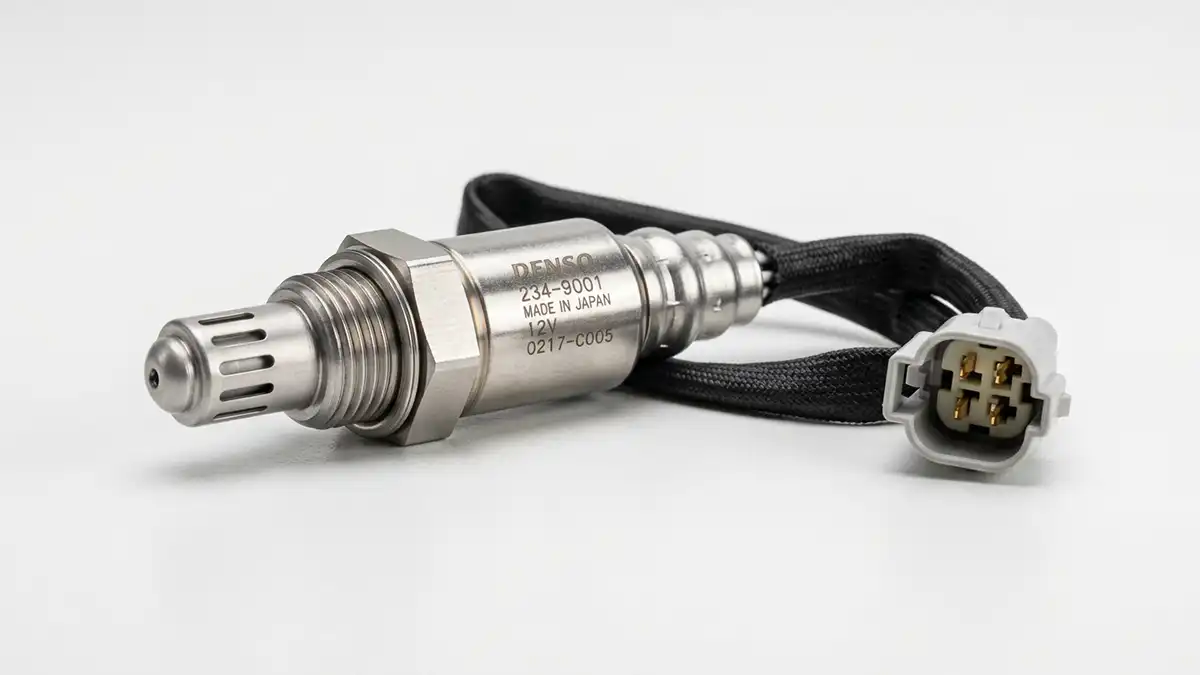
Oxygen sensors — often called O2 sensors or lambda sensors — are small probes threaded into the exhaust system. They measure the amount of oxygen in the exhaust gases and compare it to the oxygen in the outside air. The engine computer uses that reading to adjust the fuel mixture: a little more fuel if the exhaust shows too much oxygen, a little less if it shows too little.
The car aims for a near-perfect balance — not too rich, not too lean — because that balance keeps emissions low, fuel economy high, and the catalytic converter working efficiently. When a sensor fails or drifts out of range, the computer loses its ability to set the mixture correctly, and that’s when the check engine light comes on.
How many sensors does your car have?
Most cars have two to four oxygen sensors, and it’s important to know which one your code refers to. Cars with four-cylinder engines often have two sensors; V6 and V8 engines commonly have four. Sensor positions are labeled by bank and number:
| Position | Where it is | What it does |
|---|---|---|
| Bank 1, Sensor 1 | Before the converter, on the side with cylinder 1 | Sets the fuel mixture |
| Bank 1, Sensor 2 | After the converter, same side | Checks converter performance |
| Bank 2, Sensor 1 | Before the converter, opposite side (V engines) | Sets the fuel mixture |
| Bank 2, Sensor 2 | After the converter, opposite side (V engines) | Checks converter performance |
Sensors before the converter are called upstream sensors, and they do the heavy lifting for fuel control. Sensors after the converter are downstream sensors, and their main job is watching the converter. Codes like P0135 (bank 1, sensor 1 heater) and P0141 (bank 1, sensor 2 heater) point at a specific position, so you replace one sensor, not all of them.
Signs your oxygen sensor is going bad
A failing O2 sensor doesn’t always announce itself, but these are the common warning signs:
- A check engine light with an oxygen sensor code.
- Worse fuel economy than you used to get.
- A rough idle or hesitation when accelerating.
- A failed emissions test.
- A sulfur or rotten egg smell from the exhaust (which can point at a converter issue too).
Many drivers notice none of these — the light is the only clue. That’s fine. Codes like P0135 and P0141 are usually straightforward to fix, which is exactly why a shop’s diagnosis shouldn’t take long.
What an oxygen sensor replacement costs
For most cars and SUVs, replacing one oxygen sensor costs about $150 to $400, installed. The breakdown:
- Part: typically $30 to $200. Quality aftermarket sensors are usually fine; OEM sensors cost more but rarely fail sooner in normal use.
- Labor: roughly $60 to $150. Most sensors are an hour or less of work — if the threads aren’t seized.
- Total: expect $150 to $400 per sensor at most shops, with many cars landing around $200 to $300.
If you do it yourself, you pay for the part only — often $40 to $150 plus the cost of a cheap O2 sensor socket. The catch: sensors in the exhaust can seize in place, and a snapped-off sensor turns a $30 job into a $200 extraction. If you live in the rust belt or the sensor has been in for years, a shop’s torch and patience might be worth the money.
Why the price varies
O2 sensor replacement prices vary for a handful of reasons:
- How many sensors your car has. Four-sensor V6s and V8s cost more if several need replacing — but again, replace only what’s failing.
- Upstream vs. downstream. Upstream sensors sometimes cost a bit more because they include more electronics in the part.
- Accessibility. A sensor buried under the intake manifold or heat shields takes longer to reach and costs more in labor.
- OEM vs. aftermarket. Factory parts carry a premium, and some European cars only run well with them.
- Shop labor rate and region. Rates vary by city, and independent shops are usually cheaper than dealers.
Get one written quote with the exact sensor position and part type listed, and compare it against one other shop.
Codes to watch for
These are the codes that most often lead to an oxygen sensor replacement:
- P0135 and P0141 — heater circuit faults on bank 1, sensors 1 and 2. These are sensor problems, plain and simple.
- P0130 to P0134 and P0136 to P0140 — range, performance, or no-activity codes for bank 1 sensors. Often the sensor itself; sometimes wiring or a vacuum leak.
- P0171 / P0174 — lean codes that a faulty upstream sensor can contribute to, though vacuum leaks and fuel issues cause these more often. See the P0171 code guide.
- P0420 / P0430 — converter efficiency codes. A lazy or contaminated downstream sensor can sometimes trigger a P0420, but a genuinely failed converter needs a converter. Have a shop check the sensor’s live readings before assuming.
The honest rule: don’t replace a sensor based on the code alone. Oxygen sensor codes are usually right, but a code plus a quick live-data check is how the pros confirm it — and that’s what you’re paying for.
Should you replace all your sensors at once?
No. Replace the one that’s failing. Oxygen sensors fail at different times, and a car can go 100,000 miles with one original sensor and one replaced. If a shop suggests replacing all four “while we’re in there,” it’s fine to decline — there’s no evidence the others need it, and you can always replace them later if a code appears. The exception: if your car is overdue for maintenance and multiple sensors are flagged, replacing two at once can save a little labor, but it’s never required.
DIY or shop?
Oxygen sensors are one of the more DIY-friendly emissions repairs, provided the sensor comes out cleanly. You’ll need a jack or ramps, an O2 sensor socket (a special cut-out socket that fits over the wiring), and sometimes penetrating oil for seized threads. Use anti-seize compound sparingly if the new sensor didn’t come pre-coated — too much can contaminate the reading.
If the sensor is rusted, hard to reach, or the car has been driven in winter states for years, weigh the risk: a broken-off sensor adds real time and cost. When in doubt, a shop can usually do the whole job in under an hour.
Frequently asked questions
How long do oxygen sensors last?
There’s no fixed expiration date — some fail early, others last well past 100,000 miles. Many manufacturers and shops treat 60,000 to 100,000 miles as a rough service range. The practical answer: replace a sensor when it sets a code or causes symptoms, not on a schedule.
Can a bad O2 sensor damage my engine?
Usually not immediately. The bigger risks are indirect: the engine may run rich, which hurts fuel economy and loads the catalytic converter, or run lean, which can cause overheating in severe cases. That’s why it’s worth fixing within a few weeks rather than ignoring it for a year.
Will a new oxygen sensor fix my P0420 code?
Sometimes. If the downstream sensor is faulty or the exhaust has a leak, a new sensor can clear the P0420. But if the converter itself is genuinely worn out, no sensor will fix it — you’ll be replacing the converter. A live data check at a shop will tell you which situation you’re in before you spend money.