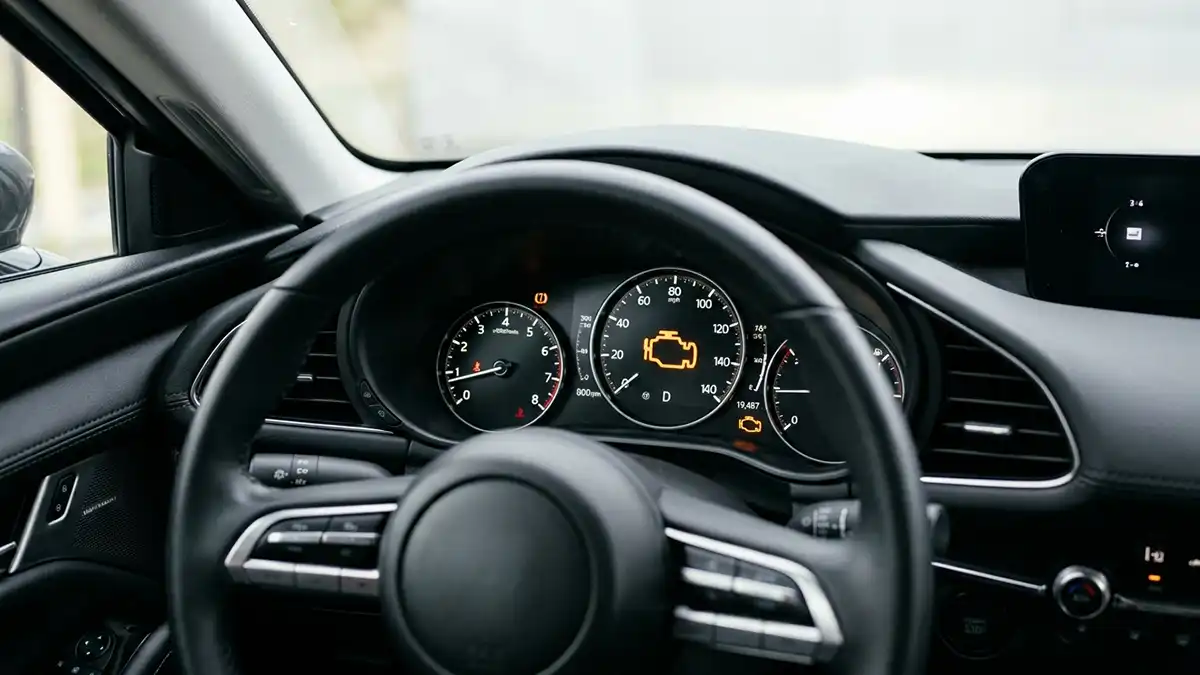
The check engine light is on in your Honda, and your first thought is probably the worst-case scenario. The good news: most Honda check engine codes point to the emissions system, not the engine. The light is usually the computer complaining about a sensor, a leak, or a small worn part — not a dying motor. This guide covers the codes Honda owners see most often, what they mean, and what to do before spending money on a repair.
How a check engine light works on a Honda
Your Honda’s computer constantly watches its sensors and compares readings to what it expects. When something falls outside the normal range, it stores a diagnostic trouble code and turns on the check engine light. The code points you to a specific system — P0420 for the catalytic converter, P0171 for a lean fuel mixture, and so on.
Reading the code is the whole game. If you don’t have a scanner, a local auto parts store will usually read it for free. One thing to keep in mind: a code names the system, not always the exact failed part.
The most common Honda codes at a glance
Honda owners report the same handful of codes over and over, across Civics, Accords, CR-Vs, and Pilots. Here’s the quick overview:
| Code | What it usually means | Urgency |
|---|---|---|
| P0420 | Catalytic converter efficiency low | Moderate |
| P0135 / P0141 | Oxygen sensor heater circuit failure | Low |
| P0300 | Random engine misfire | High |
| P0171 | Lean fuel mixture | Moderate |
| P0442 / P0455 / P0456 | Evaporative system leak | Low |
| P0128 | Thermostat stuck open | Low |
| P0401 | EGR flow insufficient | Low |
| P0340 / P0335 | Camshaft or crankshaft sensor signal problem | Moderate |
Now let’s go through the important ones in plain English.
P0420: catalytic converter efficiency below threshold
This is the Honda code you’ll hear about the most. The catalytic converter cleans harmful gases out of the exhaust, and the rear oxygen sensor watches how well it’s working. When the converter isn’t cleaning well enough, you get a P0420 code.
On higher-mileage Hondas, a worn converter is genuinely common — 100,000 miles or more of normal driving takes a toll. But before you assume the converter is bad, two things matter:
- Check for other codes first. A misfire or a bad oxygen sensor can make the computer think the converter is failing when it’s actually fine. Fix the real cause and the P0420 may go away on its own.
- Check for exhaust leaks. A leak near the oxygen sensors lets fresh air into the exhaust, which skews the readings and can trigger P0420.
A real converter replacement is the expensive end — typically $600 to $1,300 or more depending on model, parts, and labor rates. That’s why you want a diagnosis, not a guess, before paying. The car usually still drives fine with a P0420, but it pollutes more and will fail an emissions test.
Oxygen sensor codes: P0135 and P0141
Oxygen sensors measure the oxygen in the exhaust so the computer can adjust the fuel mixture. The codes P0135 and P0141 both mean the same thing on different sensors: the heater circuit inside the sensor has failed. The heater is what lets the sensor warm up quickly on a cold start.
These codes are common as sensors age. The car usually drives exactly as before — no emergency, just slightly worse fuel economy. A shop typically charges $150 to $300 for parts and labor; many owners do it themselves for the sensor alone, usually $60 to $150. It’s a straightforward job on most Honda engines.
Misfire codes: P0300 and the P0301–P0304 family
A misfire means one or more cylinders isn’t firing properly. P0300 means the misfire is random across cylinders. Codes like P0301, P0302, P0303, and P0304 point to a specific cylinder — the number is the cylinder that’s missing.
On Hondas, the most common causes are, in order:
- Spark plugs — the most common cause, especially past 100,000 miles if they’ve never been changed
- Ignition coils — the coil pack on top of each spark plug can fail one at a time
- Fuel injectors — a clogged or failed injector starves a cylinder of fuel
- Vacuum leaks — unmetered air throws off the mixture
A misfire is the code not to ignore. Every miss sends raw fuel into the catalytic converter, which can overheat and destroy it — turning a $200 plug job into a $1,000 converter bill. If the light flashes while you drive, pull over when it’s safe. Repair costs vary wildly by cause: plugs and coils run $200 to $400 at a shop; an injector is more.
P0171: the engine is running lean
A P0171 code means the engine is running lean — too much air, not enough fuel. The computer is trying to add fuel to compensate, and it can’t keep up.
On Hondas, the classic causes are:
- A dirty mass airflow sensor — coated in dirt, it reads low and the computer under-fuels
- A cracked intake hose — the rubber tube between the air filter and engine splits and lets in unmetered air; very common as Hondas age
- Vacuum leaks — a split hose anywhere on the intake side
- A failing fuel pump or clogged fuel filter — less common, but possible on older cars
The car might run fine or idle rough depending on how lean it is. A lean condition can make the engine run hot over time, so don’t park this one for months. Cleaning the mass airflow sensor is a $10 can of cleaner and 20 minutes of work; a cracked intake hose is usually a $30 to $80 part.
EVAP codes: P0442, P0455, and P0456
The evaporative (EVAP) system captures fuel vapors from the gas tank and burns them in the engine instead of letting them escape into the air. When the computer finds a leak in that sealed system, you get one of these codes:
The first thing to try is free: tighten the gas cap. A loose cap causes a large share of EVAP codes, and the light may go out on its own after a few drive cycles. If the cap isn’t it, the usual suspects are a cracked hose, a failing purge valve, or a worn charcoal canister on older Hondas. These codes never affect how the car drives, so there’s no rush — but you’ll fail an emissions test until it’s fixed.
P0128: the thermostat is stuck open
A P0128 code means the engine isn’t warming up to operating temperature fast enough — almost always a thermostat stuck open. The engine runs colder than it should, fuel economy drops, the heater blows lukewarm air, and on some models the light comes on every cold morning.
The thermostat itself is cheap, typically $20 to $50, but it can be fiddly to reach, so shop totals often land at $150 to $350. Not urgent, but worth fixing — a cold-running engine wears faster and uses noticeably more gas.
Codes Honda owners see on older models: P0401, P0340, and P0335
If you drive a Honda with some miles on it, these three show up too.
P0401 means the exhaust gas recirculation (EGR) system isn’t flowing enough, usually because carbon clogs the EGR valve or its passages. The car drives fine, but the light stays on and you’ll fail emissions. Cleaning the EGR passages is the classic fix on older Accords and Civics.
P0340 and P0335 are signal problems from the camshaft and crankshaft position sensors. These sensors tell the computer where the engine is in its rotation, and a bad signal can cause stalling, hard starting, or a no-start. If the car still runs, treat this as a moderate priority — these codes can strand you if the sensor fails. The sensors are usually $50 to $150 in parts.
What to do before you pay for a repair
A code is a starting point, not a bill. Here’s the order of operations that saves Honda owners the most money:
- Read all the codes, not just the first. A P0420 next to a P0301 tells a different story than a P0420 alone.
- Try the free fixes first — the gas cap, always.
- Look for obvious problems — cracked intake hoses, loose vacuum lines, worn plug wires — before assuming the expensive part failed.
- Get a diagnosis, not a quote. Ask a shop what they found and why. The same code can have several causes, so a shop that explains its evidence is worth more than one that just names a part.
- Skip the parts cannon. Replacing oxygen sensors to fix a P0420 without checking the converter first is how people spend hundreds they didn’t need to.
Frequently asked questions
Why does my Honda check engine light come on and then go off? The light turns off when the computer sees the condition clear for several drive cycles — common with intermittent problems like a loose gas cap, a failing oxygen sensor, or a small EVAP leak. The stored code usually remains, and if the fault comes back, so will the light. The light going off doesn’t mean the problem fixed itself.
Can I keep driving my Honda with the check engine light on? With a solid light and a smooth-running engine, usually yes — EVAP leaks, oxygen sensor codes, and P0128 are not emergencies. A misfire like P0300 deserves prompt attention, and a flashing light means stop driving soon: the catalytic converter is at risk.
How much does it cost to fix the most common Honda codes? It ranges from free to over a thousand dollars. A loose gas cap costs nothing, a mass airflow sensor cleaning about $10. Oxygen sensors run $150 to $300 installed, a thermostat $150 to $350, and a catalytic converter typically $600 to $1,300 or more. The price depends on your model, the parts you choose, and local labor rates — so get a real diagnosis before you commit.