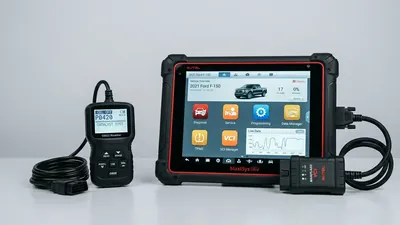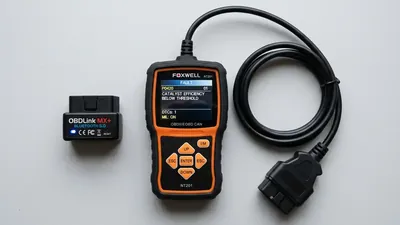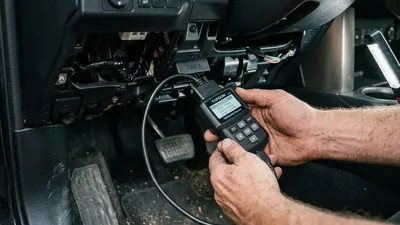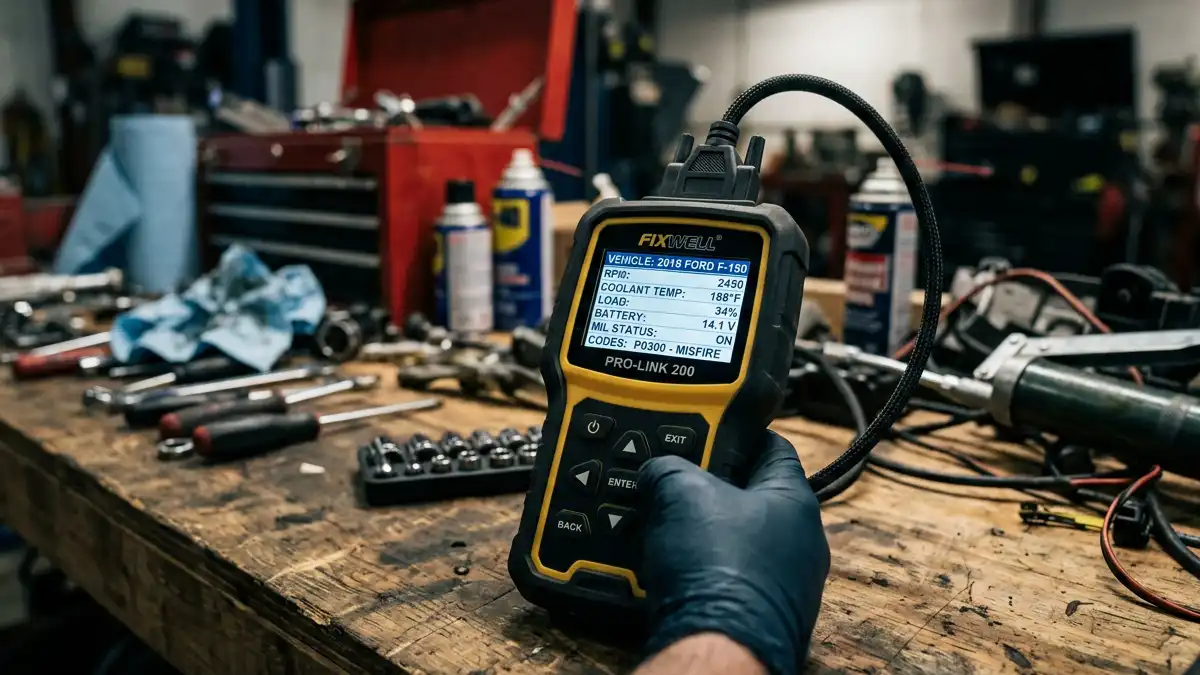
Jumping from $50 to $100 changes what a scanner can do for you. In this price range you stop being limited to reading and clearing codes, and you start getting a real diagnostic window into your engine. This guide covers the features that make the step up worth it and how to actually use them.
What the extra money buys
The $50 to $100 bracket is where scanners pick up features a basic reader lacks:
- Live data — real-time sensor readings you can watch while the engine runs
- Manufacturer-specific codes — P1xxx and P3xxx codes with actual descriptions
- Freeze frame data — the engine snapshot stored when a code set
- Emissions readiness checks — the monitors states look at before an inspection
- Faster hardware — quicker scans, bigger screens, and sometimes firmware updates
Live data is the headline feature
Live data is the single biggest reason to spend close to $100. Instead of a code that says “something is wrong with the fuel system,” you can watch the actual numbers: engine RPM, coolant temperature, fuel trims, oxygen sensor voltage, and more.
A few realistic examples:
- With a P0171 lean code, live fuel trim readings show whether the engine is compensating hard at idle or under load, which helps separate a vacuum leak from a fuel delivery problem.
- With a P0300 random misfire, watching the misfire counters on each cylinder can narrow the search to one cylinder instead of guessing.
- With a P0420 catalyst efficiency code, seeing how the oxygen sensors switch can tell you whether the converter is really failing or a sensor is feeding the computer bad information.
- With a P0128 coolant temperature code, live coolant readings show whether the thermostat is stuck open and the engine never reaches operating temperature.
That kind of information is what separates guessing from diagnosing.
Reading fuel trims like a mechanic
Fuel trims are the easiest live data values to learn, and they’re the key to many common codes. The computer constantly adjusts the fuel mixture to keep it near perfect, and it tracks those adjustments as two numbers: short-term fuel trim (quick corrections happening right now) and long-term fuel trim (the average correction the computer has settled on over time).
A healthy engine idles with long-term fuel trim near zero, give or take a few percent. If the number climbs to +15% or higher, the computer is adding a lot of extra fuel to compensate for something — usually unmetered air entering the engine (a vacuum leak) or a weak fuel supply.
Here’s how that plays out with a P0171 lean code: if the fuel trims spike at idle and settle down when you rev the engine, the leak is likely a vacuum line or gasket. If the trims climb under load instead, suspect fuel delivery — a clogged filter or weak pump. Same code, two very different repairs, and a $100 scanner’s live data tells you which direction to look. That single skill can save you from replacing parts you didn’t need.
Verifying a repair before you pay for a retest
A scanner in this range also helps you confirm your work actually fixed the problem. The process is simple: clear the code, drive the car through its normal drive cycle (a mix of city and highway driving, usually over a few days), and then check two things on the scanner.
First, confirm the original code stays gone. Second, check the readiness monitors — the self-tests the computer runs on the catalyst, EVAP system, oxygen sensors, and other emissions parts. When a monitor reads “ready,” that system has passed its self-test. If a monitor stays “not ready” after a week of normal driving, something in that system still isn’t working, and you’ll know before you pay for an emissions retest that fails.
This is a big deal for EVAP codes like P0442, P0455, and P0456, where a loose gas cap can trip the code and a tightened one is the entire fix. The scanner confirms the code cleared and the monitor completes — proof the repair is done, not just hoped for.
Manufacturer-specific codes, explained
Standardized codes cover most problems, but carmakers also write their own. These show up as P1xxx and P3xxx codes, and their meaning comes from the manufacturer, not from the generic OBD2 standard. A $50 reader often shows the number with no explanation. Many readers around $100 include descriptions for at least the common manufacturer codes, which saves you a search. Coverage varies by brand, so if you own a specific make, it’s worth checking whether the scanner’s built-in library covers it.
Emissions readiness and EVAP codes
If your state requires an emissions test, this price range is where readiness checking becomes practical. The scanner can show which monitors — catalyst, EVAP, oxygen sensor, and others — have completed their self-tests. After a battery disconnect or a code clear, those monitors reset, and a car can fail an inspection just for not being “ready.”
EVAP codes are common in this area too. A P0442 code means a small leak in the fuel vapor system, while P0455 and P0456 point to large and very small leaks respectively. A scanner in this range lets you confirm that a repair cleared the code and then watch the monitors complete their self-tests.
Features worth paying for: a quick table
| Feature | Why it matters | Where you usually find it |
|---|---|---|
| Live data with graphing | Spot trends instead of watching numbers jump around | Most $70+ units and good apps |
| Freeze frame | See engine conditions when the code set | Most models in this range |
| Manufacturer code library | Read P1xxx and P3xxx codes with explanations | Varies by brand — check coverage |
| Readiness monitors | Confirm monitors are set before an emissions test | Common around $80 and up |
| Firmware updates | Fix bugs and add vehicle coverage over time | Only some brands — worth paying for |
| ABS and airbag coverage | Read brake and restraint system codes | Usually above $100 — don’t assume |
Handheld or dongle and app?
At $100 you can still choose between a self-contained handheld and a dongle that feeds an app on your phone. Handhelds are dependable and simple, and many include a rechargeable battery and a screen big enough for live data. Dongle-and-app setups show the same data on a much larger screen, can record it over time, and usually cost less — but the app can have subscription fees, and adapter quality varies a lot. Both are legitimate; pick based on whether you want a dedicated tool or you’re comfortable using your phone.
What the repairs you’ll find tend to cost
The codes you’ll find with a $100 scanner point at repairs that vary widely in price, and the car itself drives the cost more than the part does. These are typical US-market ranges, not quotes:
- Oxygen sensor replacement often lands in the $150 to $350 range installed, depending on which sensor it is and how hard it is to reach.
- A thermostat replacement, the usual fix for P0128, commonly runs $150 to $400 installed.
- EVAP repairs for a P0442 or P0456 leak can be a cheap gas cap replacement or a pricier hose or valve repair — from well under $50 to several hundred dollars.
- Misfire repairs behind P0300 range from a $20 spark plug to a several-hundred-dollar coil or injector job.
Your actual quote will depend on the shop, the region, and the specific vehicle, so treat these as planning numbers.
When $100 still isn’t enough
There are honest limits. Bidirectional controls — commanding the car to actuate parts during testing — start higher. So do ABS and airbag code reading, advanced diagnostics on many hybrids and EVs, and any kind of programming or relearn. If you only work on your own family cars, $100 is usually plenty. If you’re chasing electrical gremlins or working on many different brands, you’ll outgrow it.
Frequently asked questions
What’s the real difference between a $50 and a $100 scanner? The big differences are live data, manufacturer-specific code descriptions, and readiness monitor checks. A $50 reader answers “what code is stored”; a $100 reader adds “what is the engine doing right now,” which is what turns a code into a diagnosis.
Will a $100 scanner read ABS or airbag codes? Usually not. Most scanners at this price talk to the powertrain computer only. Coverage of braking and restraint systems typically starts above $100, and even then it varies by brand and vehicle.
Can I pass an emissions test with help from this scanner? It helps you prepare, not pass. The scanner can show whether your readiness monitors are set and confirm that a repair cleared the relevant codes. Whether the car passes still depends on the actual emissions and your state’s rules.