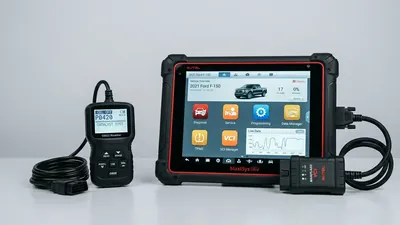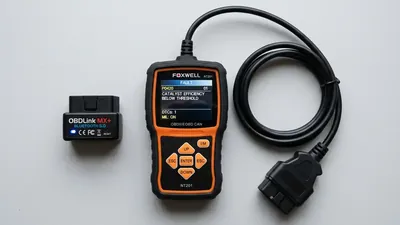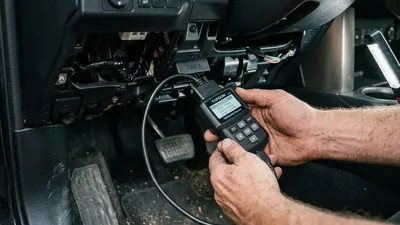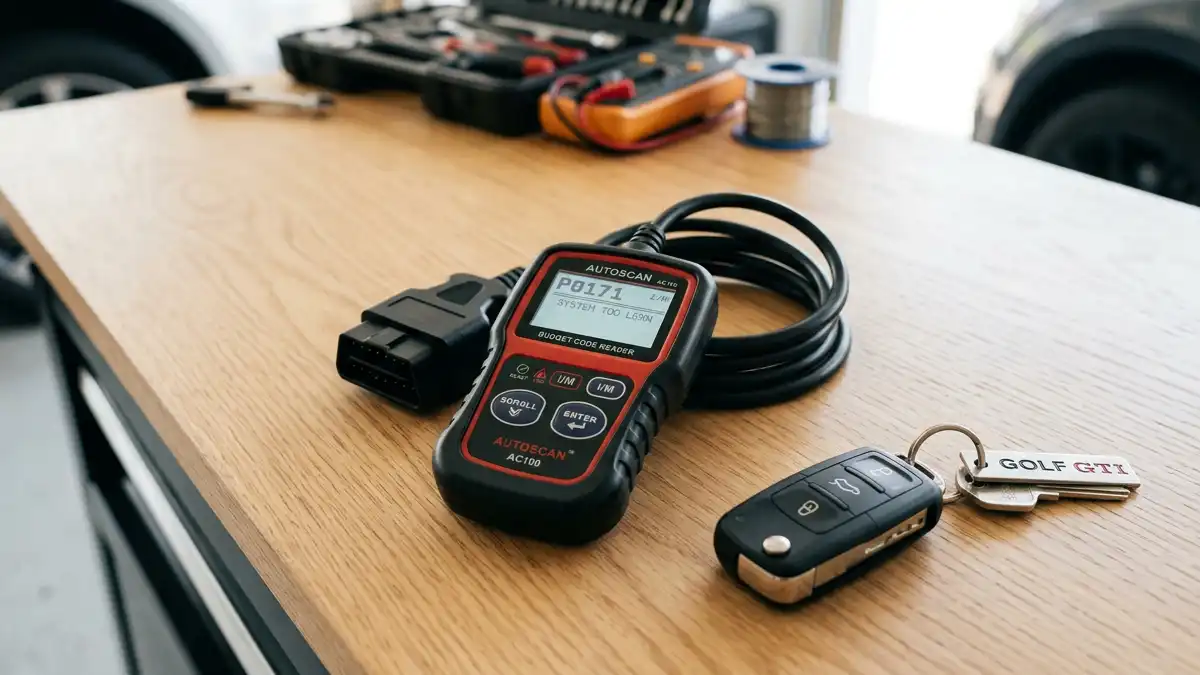
You don’t have to spend a lot of money to find out why your check engine light is on. A scanner that costs under $50 will plug into almost any car made after 1996, read the trouble codes, and usually clear the light. This article explains what a budget scanner can and can’t do, which features are worth hunting for, and how to get real value out of the one you buy.
What a scanner under $50 actually does
At this price point you’re buying a code reader, not a full diagnostic tool. That’s fine, because reading codes is the single most useful job a scanner can do. A typical sub-$50 unit will:
- Read generic powertrain codes — the P0xxx series such as P0420, P0171, and P0300
- Show a short text description of the code on its own screen, with no phone required
- Clear codes and turn the check engine light off
- Store and display freeze frame data on many models — a snapshot of engine conditions when the code was recorded
- Check emissions readiness monitors on some models, which matters before an inspection
What a budget scanner can’t do
Understanding the limits keeps you from being disappointed. The big ones:
- No live data on many models. Live data is the real-time stream of sensor readings — RPM, coolant temperature, fuel trims, and so on. It usually becomes dependable in the $50 to $100 range. Some sub-$50 units include it, but the screens are small and the refresh rate is slow.
- Limited manufacturer-specific coverage. Generic readers do a great job with standardized P0xxx codes, but many of them struggle with P1xxx and P3xxx codes, which are written by individual carmakers. You’ll often see the code number but with a blank or vague description.
- No bidirectional controls. You can’t command the car to do anything — like cycling a fuel injector or opening a valve — with a cheap reader. That’s a professional feature.
- Engine only. Most budget units only talk to the powertrain computer. They won’t read airbag or ABS codes, and they can’t help with most electric vehicle systems.
Features to look for in a sub-$50 scanner
Not all cheap scanners are equal. Before you buy, check the specs for:
- Code clearing. Some of the very cheapest units can read codes but not clear them. Make sure the model you pick can do both.
- Freeze frame data. This snapshot can tell you what the engine was doing when the code set, which helps you judge how urgent the problem is.
- A backlit screen. You’ll often be leaning under the dashboard in poor light.
- A cable long enough to hold the unit in your hand. Two feet or more is comfortable.
- Pending code support. Pending codes are conditions that haven’t fully failed yet. Seeing them early can warn you about a developing problem, like a small EVAP leak that will eventually trip a code.
- Readiness monitor access. Useful if your state requires an emissions check.
What the codes actually mean
Every code is a letter followed by four digits. The letter tells you the system: P means powertrain (engine and transmission), B means body, C means chassis, and U means network or communications. The first digit matters too: a “0” (as in P0420) means the code is standardized and means the same thing on every brand, while a “1” (as in P1131) is a manufacturer-specific code that may mean different things on different cars.
The second digit points at the system within the car:
- 1 and 2 — fuel and air metering (injectors, MAF sensor, oxygen sensors)
- 3 — ignition system (spark plugs, coils, misfires)
- 4 — auxiliary emissions controls (EVAP system, EGR, catalytic converter)
- 5 — speed and idle control
- 6 — computer and output circuits
- 7 and 8 — transmission
- 9 and 0 — network and communications
A quick glance at the code tells you roughly where to look before you even search it. The codes a budget scanner surfaces most often include:
- P0420 — catalytic converter efficiency below threshold
- P0171 — engine running lean (too much air, not enough fuel)
- P0300 — random engine misfire
- P0128 — coolant below thermostat regulating temperature
- P0442 — small EVAP (fuel vapor) leak
- P0455 — large EVAP leak
- P0456 — very small EVAP leak
Each of these has a page on our site with plain-English causes, typical fixes, and honest cost ranges. Reading the code is step one; understanding what it means is what saves you money.
Handheld or phone-app setup?
Under $50 you’ll find two styles. The classic corded handheld is simple: plug it in, read the code, clear it. It works on any car, needs no pairing, and never runs out of battery. The second style is a small Bluetooth or Wi-Fi dongle that plugs into the port and talks to a free app on your phone. Phone setups give you a bigger screen, graphs, and the ability to save and email data — but cheap dongles are often the weakest link, and some don’t play nicely with every phone. If you go the dongle route, read the reviews carefully, especially from people using the same type of phone as you.
How to get the most out of a $50 scanner
A budget scanner is only as useful as what you do with the codes it returns. A few practical habits help:
- Look every code up. The built-in text on cheap units is often vague and occasionally wrong. Cross-check the code here on our site, for example P0420 and P0171, to see the common causes and realistic fixes.
- Check for multiple codes. The light rarely comes on for just one reason. Sometimes the second code is the real problem and the first is a side effect.
- Read the freeze frame before you clear anything. Once you clear the code, that snapshot is gone.
- Don’t clear codes before a shop visit or an emissions test. A technician wants to see the stored code and the history, and many states won’t pass a car that was recently cleared.
- If the light flashes while you drive, stop and get help. A flashing light means a serious misfire that can damage the catalytic converter — that’s P0300 territory, and it’s worth treating as urgent.
When it’s worth spending more
A $50 scanner handles the most common jobs, but there are moments to upgrade. If you want live data to watch sensors while you drive, manufacturer-specific code definitions, or coverage of systems beyond the engine, the $75 to $100 range is where those features become dependable. If your only question is “why is my light on,” the under-$50 tool is hard to beat.
Frequently asked questions
Can a $50 scanner read every code on my car? No. It reliably reads the standardized P0xxx powertrain codes on any 1996-or-newer vehicle. Manufacturer-specific codes (P1xxx and P3xxx) may show up as code numbers with little or no explanation, and non-engine systems like airbags and ABS are usually not covered.
Is it safe to clear codes with a cheap scanner? Yes, clearing is a standard, safe function. Just remember it doesn’t fix the underlying problem — if the fault is still there, the light will come right back. And don’t clear codes right before an inspection or a repair visit, because the diagnostic history is valuable.
Will any sub-$50 scanner work on my car? Any OBD2 scanner will physically connect to any 1996-or-newer US car, because the port and the basic codes are standardized. Older cars, diesels, and some hybrids may need special tools, so check the compatibility notes before you buy.