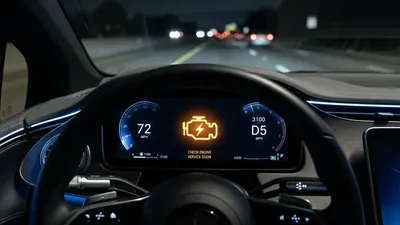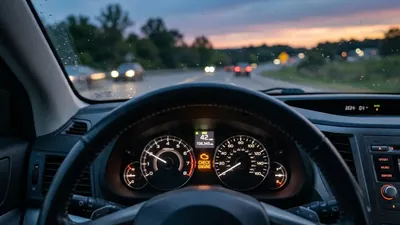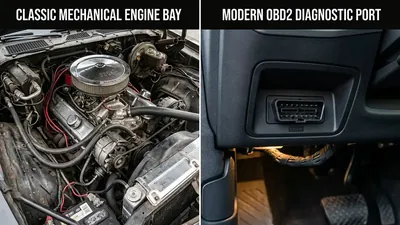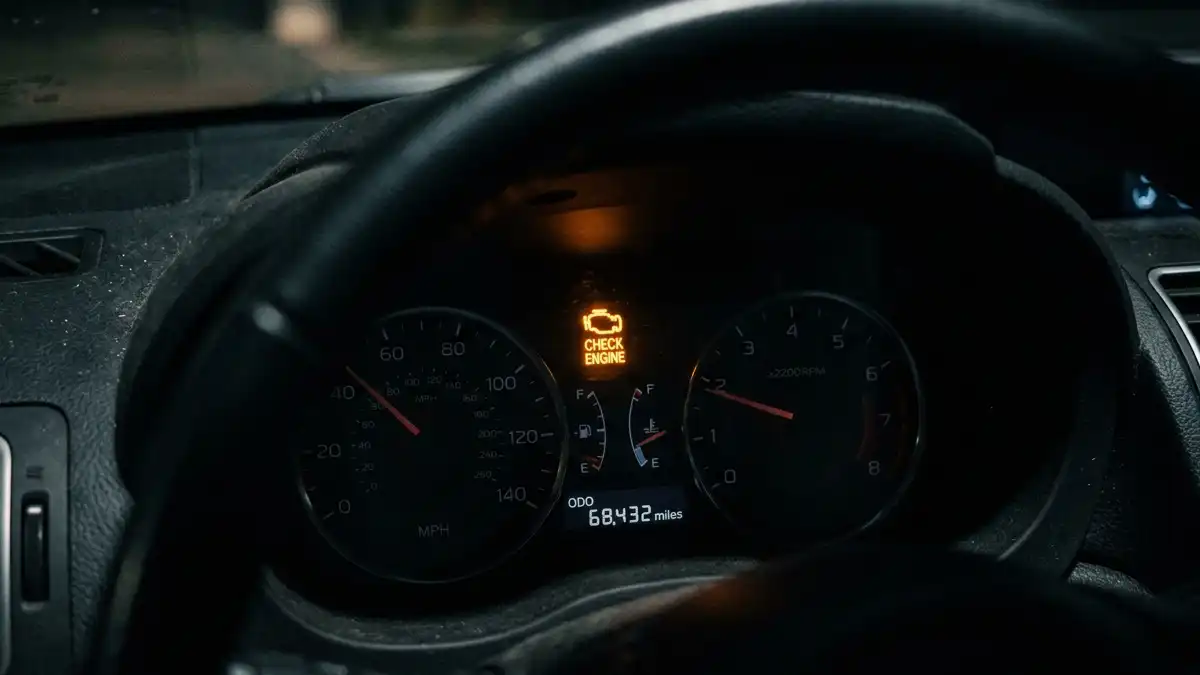
Your check engine light can do two very different things: stay lit steady, or flash on and off. A lot of drivers treat both the same way — “the light is on, I’ll deal with it later.” That is a mistake. A solid light means the car’s computer found a problem and wants you to get it checked. A flashing light means something is going wrong right now, and keeping the engine running could cost you serious money. Here’s how to tell them apart and what to do for each.
What a solid check engine light means
A solid, steady check engine light means the car’s computer (the engine control module, or ECM) has logged a fault code. The problem is real, but in most cases the car still runs and drives normally. You usually notice no difference at all behind the wheel.
Solid-light problems cover a wide range of seriousness:
- Minor: a loose or faulty gas cap that lets fuel vapors escape (an evaporative system leak).
- Moderate: a worn oxygen sensor, a thermostat that’s stuck, or a small vacuum leak.
- More serious: a slow fuel-system issue or an early warning of a component that’s aging, like the catalytic converter.
The important thing is that a solid light is a warning, not a shutdown order. You can typically keep driving for a while — days or even weeks for minor issues — while you plan a repair. That doesn’t mean ignore it forever. The longer you wait, the more likely a small problem grows into a bigger one, and many states won’t let you pass an emissions inspection while the light is on.
If you have a code reader, pull the code and look it up. For example, a P0455 or P0456 code points to an evaporative system leak — very often just the gas cap. A P0128 code means the engine is running cooler than it should, usually a stuck thermostat. Neither is a “stop driving now” emergency, but both deserve attention.
What a flashing check engine light means
A flashing check engine light is different. It almost always means a misfire — the engine is failing to burn the fuel-air mixture in one or more cylinders. The computer detects the miss and flashes the light to get your attention immediately.
Why the urgency? When a cylinder misfires, unburned fuel gets pushed out through the exhaust and into the catalytic converter. That’s a problem, because the converter is designed to clean exhaust gases, not to burn raw fuel.
If the light is flashing, ease off the gas, pull over when it’s safe, and don’t keep driving. You can read more about misfires in our guide to the P0300 code, which is the “random misfire” code — and P0301 through P0308 pinpoint a specific cylinder.
Why a misfire can wreck your catalytic converter
The catalytic converter sits in the exhaust system and does its job at very high temperatures, chemically breaking down harmful gases before they leave the tailpipe. It’s built to handle normal exhaust heat — but not the extra fuel from a misfiring cylinder.
When unburned fuel enters a hot converter, it can ignite inside it. The converter overheats, and the honeycomb inside can melt or clog. Once that happens, the converter stops working, and you’ll see codes like P0420 (converter efficiency below threshold, bank 1) or P0430 (the same problem on bank 2). Replacing a catalytic converter is one of the more expensive repairs you can do on an exhaust system — typically several hundred to over a thousand dollars including parts and labor, depending on your car.
Here’s the frustrating part: the cause of the misfire might be cheap to fix. A worn spark plug or a failing ignition coil often causes the misfire, and those parts are usually affordable. But if you keep driving with the light flashing, you can turn a $150 coil replacement into a $1,500 converter replacement. That’s the real reason the light flashes.
What to do when the light is flashing
- Ease off the gas pedal. Don’t floor it, don’t tow anything, don’t push the engine.
- Pull over as soon as it’s safe. Off the highway, in a parking lot, anywhere you can stop without blocking traffic.
- Don’t keep driving to your destination. If you’re close to home or a shop, a very short, gentle drive may be acceptable — but if you have a long way to go, call for a tow. The tow is cheaper than a converter.
- Turn the engine off once you’re stopped. Let it sit for a few minutes. If the light stays flashing when you restart, the misfire is ongoing.
- Scan for codes when it’s safe to do so. A flashing light is almost always accompanied by a misfire code, which tells you and a mechanic which cylinder or system to look at.
- If the car is shaking or has lost power, don’t drive it at all. Some misfires are severe enough that the engine can barely run, and driving in that condition can cause much worse damage.
What to do when the light is solid
With a solid light, you have more room to work with:
- Check the gas cap first. It’s the most common cause of evaporative system codes and costs nothing to fix. Tighten it until it clicks a few times. The light may take a few days of driving to go out on its own.
- Read the code. Use your code reader and write down the exact code. Look it up in plain English.
- Watch how the car behaves. If it’s running smoothly and nothing feels off, you can usually drive normally while you schedule a repair. If it starts running rough, stalling, or losing power, treat it like a flashing light.
- Get it fixed within a reasonable time. For most solid-light issues, that means days to a few weeks, not “someday.”
Solid vs flashing at a glance
| Light | What it usually means | Urgency | What to do |
|---|---|---|---|
| Solid | A fault is stored; car usually drives fine | Medium | Check the code, schedule a repair |
| Flashing | A misfire is happening right now | High | Pull over, don’t drive far, get a tow if needed |
Frequently asked questions
Can I keep driving with a flashing check engine light? No. A flashing light means the engine is misfiring, and unburned fuel is damaging the catalytic converter. Pull over when it’s safe and don’t drive further than a short, gentle distance to home or a shop. If you have a long way to go, call a tow.
Why is my check engine light flashing but the car feels fine? A misfire can be intermittent — it may happen only under load, at certain speeds, or when the engine is cold. The car can feel normal most of the time while the computer still detects the misses and flashes the light. The damage to the converter can still happen even if you don’t feel anything.
Will the flashing stop if I keep driving? Sometimes the misfire stops on its own once engine conditions change, and the light will go solid or out. But that doesn’t mean the problem is fixed — the cause is still there, and the converter may already be damaged. Get the codes read and the misfire diagnosed instead of hoping it goes away.