When your scanner shows a code like P0420 or P0171, the most useful information isn’t the code itself — it’s the freeze frame data stored right next to it. Freeze frame data is a snapshot of your engine’s readings at the exact moment the computer decided something was wrong. Learning to read it turns you from someone who just sees a code into someone who understands what was happening when the code appeared.
This guide explains what freeze frame data is, how to find it on your scanner, and what each reading actually tells you.
What freeze frame data is
Your car’s computer (the PCM, or powertrain control module) constantly watches dozens of sensors. When one reading falls outside the acceptable range, the computer stores a diagnostic trouble code. Along with that code, it saves a “freeze frame” — a record of key engine readings from that same moment.
Think of it like a security camera freeze-frame at the exact second a package was dropped on your porch. The code tells you something happened; the freeze frame tells you what the engine looked like when it happened. That difference matters, especially for problems that come and go. A code that’s stored but never reproduced is frustrating; freeze frame data is often the only clue about the conditions that triggered it.
How to find freeze frame data
Almost every scanner can show it, though the menu name varies:
- On many handheld scanners, look for a “Freeze Frame” or “Snapshot” option after reading codes.
- On phone apps paired with a Bluetooth adapter, look for the same option under the codes screen — sometimes labeled “Frames” or “DTC Info.”
- On some scanners you must select the code first, then choose “Freeze Frame” to see the data recorded for that code.
If you don’t see it, check your scanner’s manual — some cheap code readers omit it. A scanner that shows freeze frame data is worth having, because this feature alone can save you a diagnostic fee later.
The key readings and what they mean
Freeze frame data varies by make and model, but most include the readings below. You don’t need to understand all of them — focus on the ones that match your symptom.
| Reading | What it means | Why it matters |
|---|---|---|
| RPM | Engine speed at the moment of the fault | A misfire at idle is a different problem than a misfire at highway speed |
| Vehicle speed | How fast the car was going | Helps you reproduce the problem on a test drive |
| Coolant temp | Engine temperature in °F or °C | A code while the engine is cold points to temperature-related parts |
| Engine load | How hard the engine is working | High load + high RPM often means a fuel or airflow issue under acceleration |
| Short-term fuel trim (STFT) | Fuel adjustment happening right now | Large swings suggest a vacuum leak or fuel delivery problem |
| Long-term fuel trim (LTFT) | Long-term fuel correction the computer has learned | Permanently high or low values point to a real, ongoing issue |
| Throttle position | How far the gas pedal is pressed | Tells you if the fault happens at idle, cruise, or wide-open throttle |
Fuel trims deserve extra attention
Fuel trims are the readings that diagnose more driveability problems than any other. In plain terms:
- Short-term fuel trim (STFT) is the computer’s immediate, moment-to-moment correction to keep the air/fuel mixture correct.
- Long-term fuel trim (LTFT) is the average correction it has learned to apply over time.
A reading near 0% means the mixture is fine. A high positive number (like +20%) means the computer is adding a lot of extra fuel — usually because unmetered air is sneaking in (a vacuum leak) or the P0171 lean condition is present. A very negative number (like −15%) means the computer is pulling fuel out, which often happens with a rich condition or a bad sensor. If you see a fuel trim stuck at an extreme value in a freeze frame, that’s a strong clue the fault is in the fuel or air system, not a random glitch.
How to read a freeze frame: three examples
Knowing the numbers only helps if you can put them together. Here are three common scenarios.
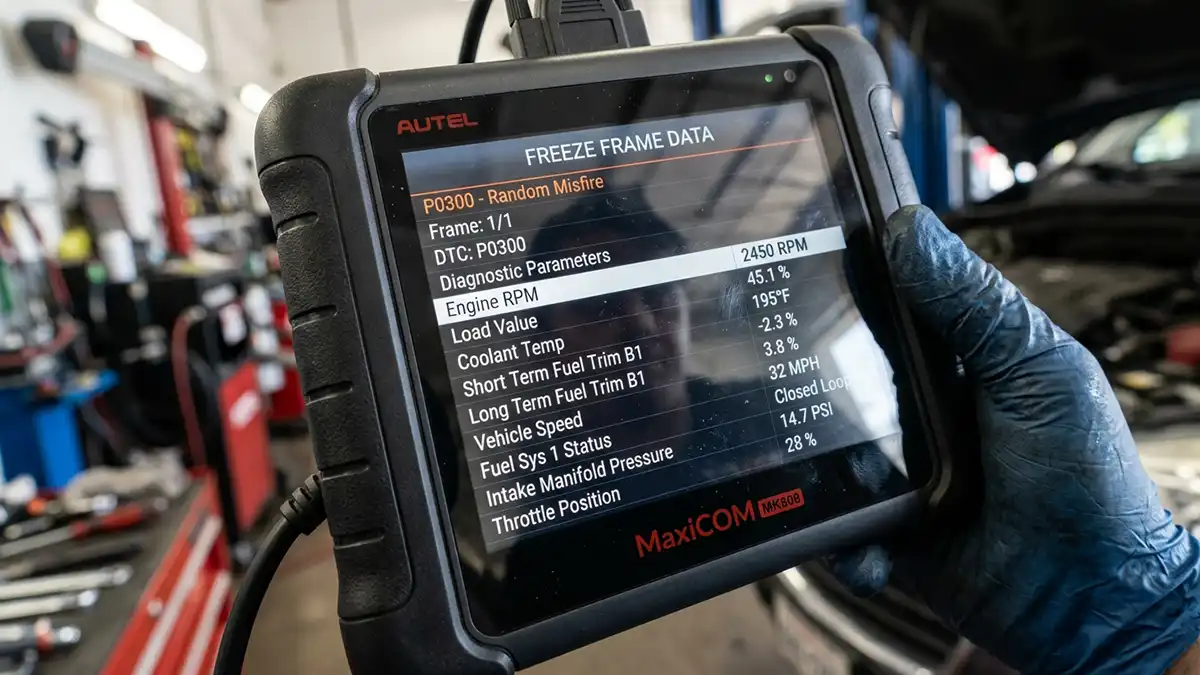
Example 1: Misfire at highway speed. Your scanner shows a P0300 (random misfire) with a freeze frame showing 55 mph, 2,500 RPM, and 40% engine load. The fault happened under load at speed — a common zone for ignition coil or spark plug failures. If the freeze frame instead showed idle RPM and near-zero load, you’d focus on vacuum leaks or idle components instead.
Example 2: Lean code on a cold engine. You have a P0171 (system too lean) with a freeze frame showing coolant temp at 70°F — far below normal operating temperature. That tells you the code set while the engine was still warming up, which points toward a cold-start issue like a leaking intake gasket or a failing sensor, rather than a fuel pump problem that would show up at any temperature.
Example 3: Catalyst code at steady cruise. A P0420 (catalyst efficiency below threshold) freeze frame showing a long steady-cruise segment is typical, because the catalyst monitor only runs under specific conditions. That tells you the code is probably a genuine converter problem — the monitor completed its test and failed — rather than a fluke.
What freeze frame data can’t tell you
Freeze frame data is a starting point, not a verdict. It won’t tell you which part is bad — a P0300 freeze frame won’t name the failing cylinder. It also records conditions at one instant, so it won’t capture a problem that happens only every few days. And on some cars, the freeze frame for a second, third, or fourth code may be overwritten by newer data, so the snapshot you’re looking at might belong to an older fault.
Use the data to form a guess about where to look, then confirm it. If you’re not comfortable doing that, write down the key freeze frame numbers and hand them to your mechanic along with the code — it gives them a head start and can shorten the time they need to charge you for.
The practical takeaway
When you pull a code, always scroll past the code itself and read the freeze frame before clearing anything. Clearing the code erases the freeze frame too, and that snapshot can be the single most valuable piece of evidence you have. If the light comes back, having the freeze frame recorded lets you compare conditions — same RPM? Same temperature? Same speed? — and that pattern is often the real diagnosis.
If the numbers look normal in every way, that’s still useful: it often means the fault is intermittent and tied to something not captured in the snapshot, like a loose wire or an intermittent sensor, and a shop with professional tools may need to chase it with live data instead.
Frequently asked questions
Where is freeze frame data stored? Inside your car’s computer (PCM) as part of the diagnostic record for each stored code. It’s read through the OBD2 port, so any scanner that supports the feature can display it — the data itself lives in the car, not the scanner.
Does clearing a code erase the freeze frame? Yes. When you clear a code with a scanner, the freeze frame data for that code is deleted along with it. That’s why it’s smart to write the numbers down or take a photo before you clear anything.
Can freeze frame data tell me which part to replace? No — it describes engine conditions, not failed parts. It narrows down when and how the fault happens, which helps you or a mechanic decide what to test, but you still need inspection or testing to confirm the actual part.