The OBD2 port is the little plug your code reader connects to, and every car built since 1996 has one. Finding it is usually a 30-second job once you know where to look. This guide covers the most common locations, how to find it when it’s hiding, and what to do if your scanner won’t power on once you plug it in.
What the OBD2 port looks like
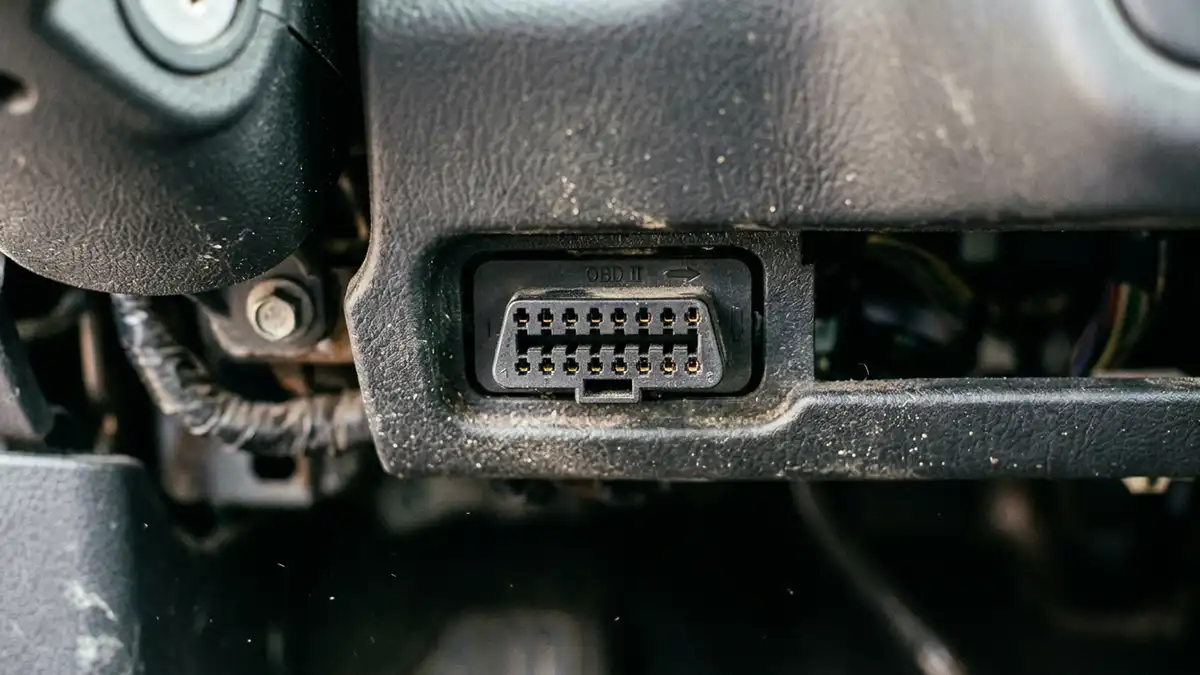
Before you go hunting, it helps to know what you’re looking for. The OBD2 port is a trapezoid-shaped connector with 16 metal pins inside — the bottom edge is wider than the top. It’s usually made of dark gray or black plastic and often has a small label nearby that says “OBD II” or “DLC” (which stands for Data Link Connector).
Your scanner plug only fits one way, and the port has a notch to guide it, so you won’t damage anything by trial and error. Once you see one, you’ll recognize them in every car from then on — the shape is identical across all makes and models sold in the US since 1996.
The #1 spot: under the driver’s dashboard
In the vast majority of cars, the OBD2 port is under the dashboard on the driver’s side, close to the steering column. Get in the driver’s seat, put your head down near the pedals, and look up under the dash. You’ll usually find the port within a couple of feet of the steering wheel, often:
- Directly beneath the ignition switch area
- Right next to the hood release lever
- Just above your left knee, tucked against the side wall
- Below and slightly left of the steering column, facing down or toward you
There’s a reason it’s almost always within arm’s reach of the driver: federal law requires the port to be reachable from the driver’s seat without tools, so a technician can plug in a scanner and run the car’s self-diagnostics. It also means the port is typically near the fuse box, which is why you’ll often see it sharing space with fuse panels and relays.
Other places carmakers hide it
Not every car follows the exact same pattern. While the driver’s side under-dash area is the standard, some models — especially minivans, trucks, and some imports — tuck the port in a less obvious spot. Check these locations in order:
- Behind a small flip-down panel or cover under the dash, sometimes labeled “OBD” or “DLC”
- Up under the dash against the firewall, near where the steering column passes through
- Inside or behind the glovebox, either clipped to the side or above the opening
- In the center console storage bin, under the armrest
- Beneath the ashtray or a small cubby in the center stack (common on older cars)
- On the driver’s side kick panel, the plastic trim just forward of the door opening
- Under the dashboard on the passenger side, which a few imports use for space reasons
If a previous owner installed an aftermarket security system or remote start, the port can sometimes end up relocated or hidden behind extra wiring. And on some trucks and SUVs, it’s mounted higher than you’d expect — right up under the dash rather than down near the pedals.
How to find it in about five minutes
If the port isn’t visible right away, use this simple routine instead of tearing the car apart:
- Grab a flashlight — the port is often in shadow, and a phone flashlight works fine.
- Sit in the driver’s seat and look under the dash near your knees and the steering column.
- Feel around with your hand — the port has a distinctive rectangular shape with a wide opening; you’ll know it when you touch it.
- Check every small cover or panel in that area. Many are just friction clips; they pop open with a gentle pull.
- Use your phone camera to look in tight spots — hold it up under the dash, record or take a photo, and review it. This works surprisingly well for ports that face up and away from you.
The port is almost never buried under carpet or inside the wiring loom on purpose. If you’re searching more than ten minutes, you’re probably looking in the wrong area rather than the right one hidden deeper.
What to do if you still can’t find it
Some cars are genuinely tricky. If your search comes up empty:
- Check the owner’s manual — look in the index under “OBD,” “diagnostic connector,” or “emissions.” The manual often includes a diagram.
- Search online for your exact year, make, and model plus the words “OBD2 port location.” For popular cars you’ll usually find photos or a short video showing the spot.
- Ask a parts store or a mechanic — most parts stores will plug in a scanner for free to read your codes, and they see dozens of cars a day. They can point you right to it.
- Look for a port-shaped cover you may have mistaken for a fuse access panel. Some cars hide the port behind a door that’s flush with the dash, and it’s easy to walk right past.
If you own a classic or a very old car, remember that only vehicles from 1996 onward are required to have the standardized OBD2 port. If your car is older, it may have an earlier connector, which usually needs a special adapter.
Why your scanner might not power on
Plugging in is only half the battle — sometimes the scanner powers on but won’t communicate, or doesn’t power on at all. Before you blame the scanner, check these:
- Is the port covered or blocked? Some cars have a plastic dust cover that looks like part of the port.
- Is the ignition on? Most scanners need the key in the ON position (engine off) to wake up the car’s computer.
- Is there a blown fuse? The port shares a fuse with the cigarette lighter or accessory socket in many cars. If your lighter is dead too, check that fuse first.
- Are the pins dirty or bent? A port that lives under the dash usually stays clean, but if a connector was forced in at some point, a bent pin can stop communication.
A port that won’t power the scanner is not the same as a port that’s missing. If everything looks right but the scanner still won’t connect, the issue is usually the fuse or the scanner itself.
Once you’re plugged in
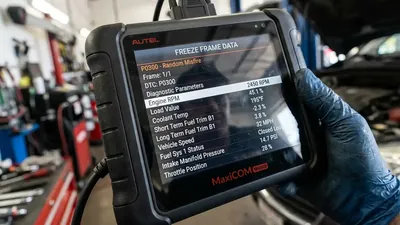
Finding the port is the first step to answering the big question: why is the check engine light on? With the scanner connected and the ignition on, you can pull the stored codes and look them up — for example, P0420 points to a catalytic converter efficiency problem, P0171 means the engine is running lean, and P0300 means random misfires. Knowing where the port is gets you from “light is on” to “here’s what’s wrong” in a few minutes.
Frequently asked questions
Is the OBD2 port in the same place on every car? No, but it’s close. About 9 out of 10 cars put it under the driver’s dashboard near the steering column. The rest use spots like the glovebox, center console, or kick panels. The port shape is standardized, but its exact location is not.
Do I need any tools to reach the OBD2 port? Usually not. The port is required to be reachable from the driver’s seat without tools. If it’s behind a cover, that cover typically pops open by hand or with a gentle tug.
Can I find the port on my own or do I need a mechanic? You can absolutely find it yourself. Use a flashlight, check the under-dash area near the steering column first, and fall back on your owner’s manual or a quick online search for your exact car model if it’s not obvious.